
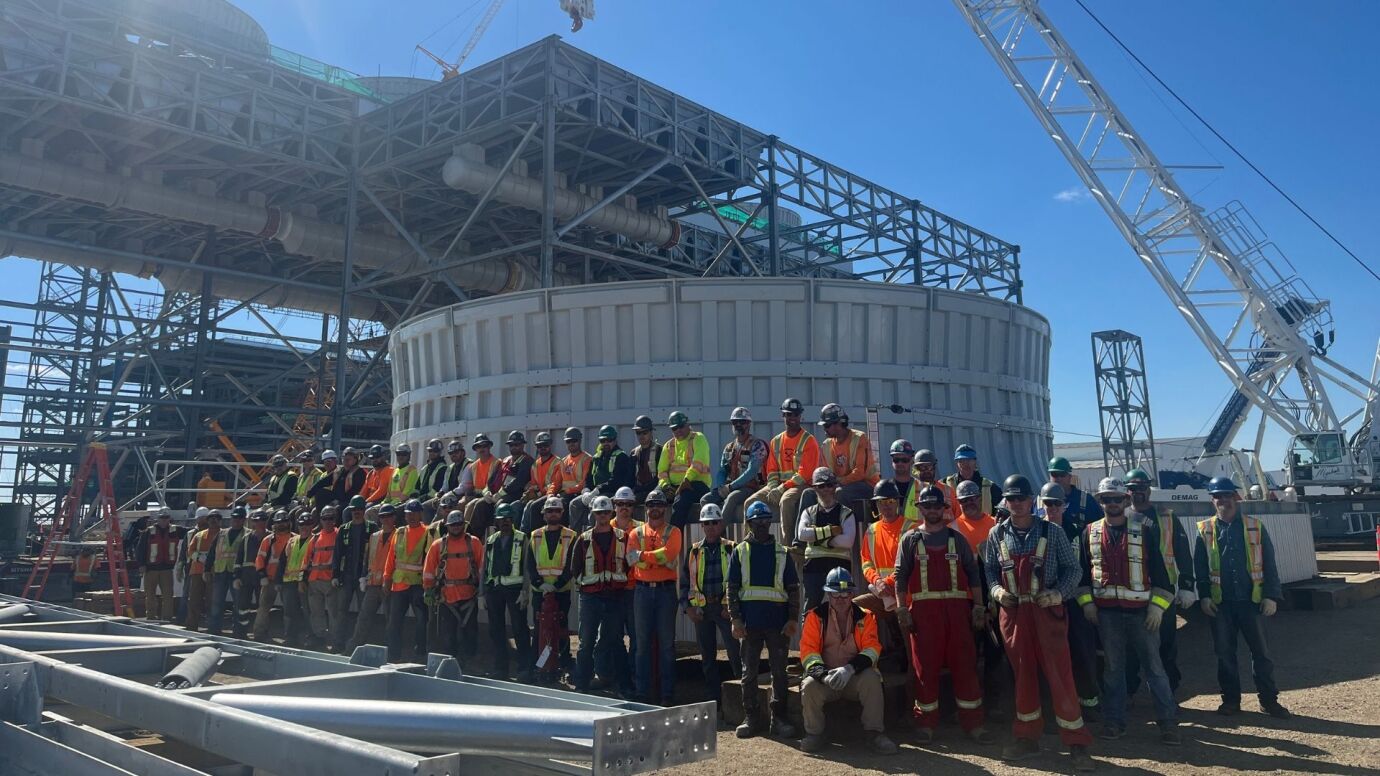
Black & McDonald’s ongoing work at SaskPower’s new Aspen Power Station—a 370‑megawatt natural gas facility near Lanigan, Saskatchewan—has become a standout example of technical excellence, cross‑trade coordination, and disciplined project planning. The project spans three major scopes delivered under a single site‑wide program managed by Burns & McDonnell, with SaskPower as the end user. These include the Air-Cooled Condenser (ACC), the Water Treatment Building, and HVAC for the Gas Turbine Powerhouse.
Division Manager Joel Goy noted that mobilization began in January 2025, with each scope advancing on staggered timelines. The ACC installation—now nearing completion—has emerged as a showcase of technical execution and innovative problem‑solving. The team began with more than 1,100 metric tons of structural steel, followed by installation of 14 large cooling fans, motors, fan blades, sheet metal, piping, electrical heat trace, and instrumentation.
A defining feature of the project is the massive thermal exhaust duct (TED), which channels heat from the power plant up into the coolers before releasing it safely to atmosphere. Delivered in four large sections, the largest measuring approximately 15 feet in diameter, the TED has become one of the project’s most technically impressive components.
“The manufacturer’s recommended method was to assemble the duct 50 feet in the air, requiring extensive scaffolding and exposing workers to significant elevation risk,” Goy said. “Instead, our team, lead by Project Superintendent Brad Konanz, proposed an innovative alternative to assemble and dry‑fit the duct on the ground. We brought in our VDC team to scan the assembled duct, scan the structure, and model the two together to confirm it would fit as a single lift.”
The results were exceptional. The approach saved scaffolding costs, dramatically reduced work‑at‑height exposure, and enabled a successful single‑piece lift and installation. Overall, the outcome was so effective that the manufacturer is now considering adding this method as an approved alternate installation procedure in their official manual.
“The team worked collaboratively—internally, with the engineer, and with the client—and that collaboration allowed us to develop innovative solutions like this,” Goy added. “It improved the schedule and enhanced safety.”
Key Accomplishments to Date
- Structural steel erection: 1,184 metric tons
- Deck plate installation: 83 metric tons
- NHE module assembly: 790 metric tons
- SDM module installation: 202 metric tons
- Thermal exhaust duct assembly: 180 metric tons
- Engineered critical lift plan for heat exchanger and plenum modules
- Integration with ATO piping, heat trace, coating, insulation, and electrical systems
- Over 100,000 man‑hours logged with zero recordable injuries
A Multidisciplinary Effort
The Aspen Power Station project has brought together a wide range of trades and technical specialists—from pipefitters and boilermakers to labourers and crane operators—resulting in a deeply collaborative effort across mechanical, structural, electrical, and piping disciplines.
“Everyone played a role in making this successful,” Goy said.
The project is being executed through Willow Cree Project Services, a limited partnership with the Beardy’s & Okemasis Cree First Nation. Willow Cree holds the contract with Burns & McDonnell and SaskPower, adding a meaningful community‑based dimension to the work.
As the ACC and related scopes near completion, the Aspen Power Station stands as a powerful example of what B&M teams can achieve through innovation, collaboration, and disciplined execution.
“If we get another opportunity like this, absolutely we’d repeat these methods,” Goy said. “These projects don’t come around every day—but when they do, we want to be ready to deliver them even better.”
Special thanks to the countless dedicated team members who’ve contributed to this exciting project!
